The Evidence Behind AI Learning Video: What the Research Actually Says
By Amjid Ali · · Updated · 4 min read
In this article
Before anyone builds a tool category, it helps to ask whether the underlying premise is sound. In EdTech, that question is: does video actually improve learning outcomes, or does it just make learners feel like they learned more?
The distinction matters. “Learner satisfaction” and “knowledge retention” are not the same metric, and EdTech has a long history of confusing the two. Platforms that felt engaging produced learners who felt confident but tested poorly.
The research on video-based learning is more nuanced than the category’s marketing would suggest. Here’s what it actually shows — and where AI learning video specifically fits in the evidence picture.
What the Research Shows About Video and Learning
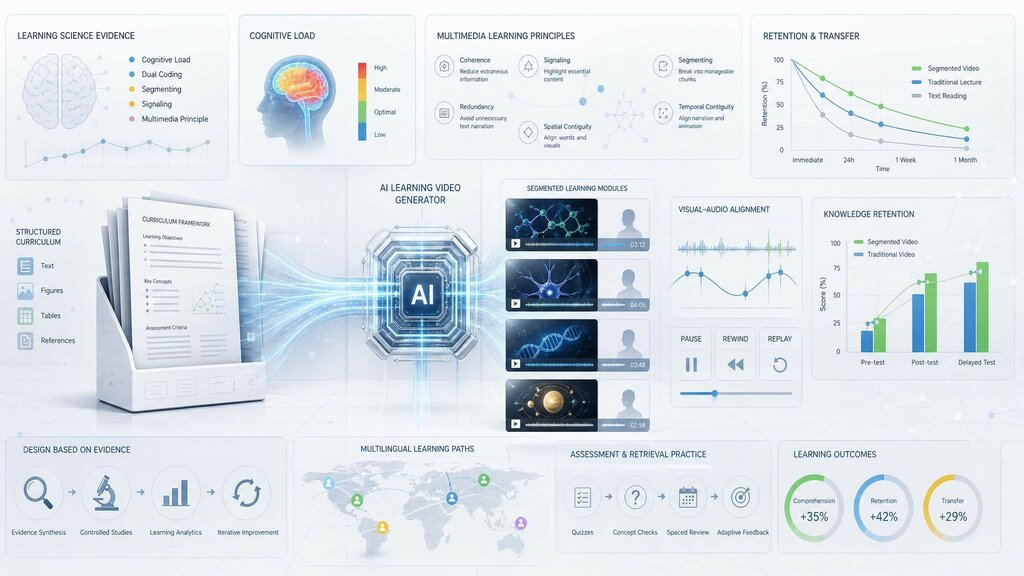
The most robust findings come from cognitive load theory and multimedia learning research. Richard Mayer’s work at UC Santa Barbara, replicated across dozens of studies, establishes a few consistent patterns:
Narrated video outperforms text for complex procedural content
When learners need to understand a process — how a biological system works, how to execute a multi-step technical operation — narrated video produces significantly higher comprehension scores than equivalent text. The mechanism is well understood: simultaneous visual and auditory processing of aligned content reduces cognitive load compared to reading alone.
The advantage disappears or reverses for simple declarative content
A list of facts presented as a video is not more effective than the same list as text. The video format adds cognitive overhead (loading the player, tracking the narration) without delivering the compensating benefit of process visualization. This is why flashcard apps and practice quizzes remain text-based even as the broader EdTech industry has shifted toward video.
Segmented video outperforms continuous video
Learners who can pause, rewind, and control pacing retain more than those watching at a fixed pace. The implication is that video designed for passive broadcast (a recorded lecture at a fixed pace) is measurably less effective than the same content delivered in learner-controlled segments.
Talking heads add limited value unless the subject matter benefits from human demonstration
An AI avatar explaining a chemistry reaction is no less effective than a human instructor doing the same, according to multiple controlled studies. What matters is the quality and clarity of the explanation, not whether the presenter is biological.
Where AI Learning Video Tools Fit
The evidence above suggests that AI-generated video is particularly well-suited for:
- Conceptual and procedural content where process visualization adds value over text
- Content delivered in learner-controlled segments rather than continuous lecture format
- Multi-language learner populations where native-language delivery improves comprehension
An AI learning video generator that takes structured content — a curriculum outline, a training document, a course module — and converts it into narrated, segmented video addresses the first two conditions directly. The segmentation is built in. The narration is aligned to the visual content. The format matches what the research shows actually works.
The multilingual component is worth expanding on: the comprehension gap between learners receiving content in their native language versus a second language is substantial — often 20 to 30 percentage points on retention tests. AI video tools that generate translated versions from a single source document address this systematically rather than treating it as an expensive edge case.
What the Research Doesn’t Support
“Video is always better.” This is false. For simple content, the overhead of video production — and video consumption — doesn’t justify the format. Not every learning objective benefits from video.
“Longer is better.” The evidence strongly favors short segments. 6 to 12 minutes per module is the range most consistently associated with completion and retention. This isn’t a psychological trick; it’s a function of working memory capacity.
“Learner preference is a proxy for learning effectiveness.” Learners frequently prefer more engaging formats while retaining less. A 20-minute video with production polish is preferred by learners over a 10-minute clearly structured video — but the retention outcomes favor the shorter, better-structured version.
Applying This to AI Video Tool Selection
When evaluating an AI learning video generator, the research-based checklist looks like this:
- Segment length control: Can you control or limit video length per segment? Tools that produce 30-minute continuous videos aren’t aligned with the evidence.
- Narration-to-visual alignment: Does the audio narration correspond precisely to the on-screen content, or is there misalignment? Misalignment increases cognitive load.
- Multilingual output: Can the same content be generated in multiple languages from one source? This matters significantly for diverse learner populations.
- Export compatibility with LMS platforms: Completion tracking requires SCORM or xAPI compatibility. Learner-controlled viewing requires a player that supports pause and rewind, not just video autoplay.
- Iteration speed: How quickly can you update content when source material changes? Learning videos that can’t be updated quickly goes stale and loses accuracy.
The research base for video learning is solid enough that the format decision isn’t really the debate anymore. The debate is about execution quality and tool selection — which is where the differences between AI video platforms actually matter.
Keep reading
 Tech NewsBase44 Review: Build a Custom Internal CRM Without Managing a StackBase44 review: can its built-in backend and integrations help a small technical team build a custom internal CRM without managing a stack? · 8 min read
 Tech NewsThe Triple-A Framework: How to Improve Brand Visibility in AI Search EnginesIt’s 2026. If your marketing strategy still revolves around keyword density, ten blue links, and traditional search engine results pages (SERPs), your · 8 min read
 Tech NewsZapier Review: Building Reliable App Automations for a Small Technical TeamZapier is a broad automation platform for connecting the software a team already uses. This review explains its workflows, built-in tools, task model, and where it fits beside more hands-on automation approaches. · 9 min read