Cloud and Self-Hosting
Database Migrations and Legacy Systems: Modernizing Access to Public Financial Data
By Amjid Ali · · Updated · 5 min read
In this article
- The COBOL Database That Still Holds Billions
- Understanding the Legacy Landscape
- Migration Strategy: Big Bang vs Incremental Approach
- Building Middleware: The API Wrapper Solution
- Data Transformation and Schema Modernization
- Testing and Validation in High-Stakes Environments
- Managing Technical Debt and Future Modernization
- The Long Road to Modern Government IT
The COBOL Database That Still Holds Billions
In most government organizations, the most important financial information is stored in 30 to 50-year-old systems. COBOL mainframe financial systems are used to support billions of transactions in many state financial systems every year. These systems are not outdated failures. They are success stories in operation since they have survived several technology cycles. The problem is not to change them immediately, but to modernize access without interfering with the mission-critical activities.
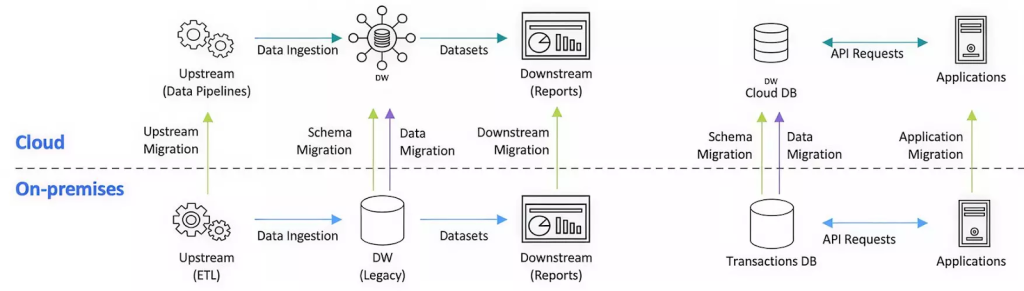
Phased migration architecture showing legacy on-premise databases transitioning to cloud systems without service disruption.
APIs, real-time queries and analytics-friendly schemes are expected by modern users and applications. This was not what legacy systems were meant to do. This article discusses how organizations can modernize their access to public financial data by moving there gradually through incremental migration, middleware, and cautious architectural design instead of doing it more crucially by completely replacing their system.
Understanding the Legacy Landscape
Government inherent environments are mixed. At the heart of these are the mainframe systems that use COBOL and the data is stored in IBM DB2 or IMS or in the fixed-width flat files. These are enclosed in the platforms in the client-server era that are developed using tools like Oracle Forms or PowerBuilder. They also tend to have restricted access to data that is only available in green screen terminals or batch exports.
There is a tendency for documentation gaps. Specifications are not complete or are lost and critical business logic is then implemented on stored procedures or application code and only understood by a limited number of experts. These systems work within tight limitations. There is no tolerance for downtime and the availability may be 24/7 as well as regulatory constraints may not allow one to directly modify core logic.
Research always indicates that a majority of government organizations use legacy systems in their central financial activities. Replacement may not be feasible at all because of the cost, risk and institutional dependence. Consequently, modernization is concerned with access and not abolition.
Migration Strategy: Big Bang vs Incremental Approach
Early modernization initiatives tended to have big bang migrations, wherein whole systems were changed simultaneously. These practices often did not work in government settings, leading to cost overruns, service failures or data corruption.
The incremental strategies take over. The strangler fig pattern will over time supersede functionality as it routes use cases via modern components whilst legacy systems remain operational. Parallel run systems keep both old and new systems running at the same time, and can be validated and rolled back in case of problems.
One of the most difficult issues is data synchronization in the case of transition. There should not be a clash between changes in systems. Strong rollback features are also required, since failure should be invertible. No psychological factors are indifferent. Legacy users are under the need to trust the new interfaces, which are developed not as fast as new features.
Building Middleware: The API Wrapper Solution
Middleware has been a choice of modernization layer. An abstraction layer insulates the modern apps against the complexity of legacy by revealing a standardized API. REST interfaces are interfaces that convert old protocols known to mainframe systems with the help of HTTP and JSON requests.
Connection pooling is necessary sincethe mainframe connection is costly and scarce. Caching algorithms are used to offload vulnerable servers, thereby leading to the provision of previously accessed information without re-queries. Error handling converts obscure legacy error codes into meaningful messages to be taken by the developer and the user.
Firms such as Claim Notify have adopted advanced middleware architecture that offers modern API access to the old state databases and gives credit to the shortcomings and availability restrictions of systems that were decades old. A typical requirement is protocol translation, e.g. SOAP to REST or EBCDIC to ASCII. Under some circumstances, with middleware designed and optimized, performance benchmarks incur minimal overhead.
Data Transformation and Schema Modernization
The old schemas are frequently highly normalized or in a format that is not easily consumed by the modern systems. Modernization visibly converts the fixed-width flat files into relational or analytical formats, which make them read-only, and denormalizes data to access patterns that are read-heavy.
The nature of the COBOL format like packed decimals requires that they be decoded correctly to maintain financial accuracy. Date fields should be handled with great care and Julian dates and two-digit year representations. The encoding of characters is done in a way that makes them consistent across systems.
Old platforms may not have an actual NULL value, and sentinel values have to be interpreted. Data constraints that contain business rules need to be replicated and recorded. Referential integrity is often implemented at the application level and it has to be reinstated explicitly in the redesigned schemas.
Testing and Validation in High-Stakes Environments
Migration to legacy requires testing. Representative test datasets are produced through the use of production snapshots. Regression testing will guarantee that all the legacy functions will behave the same way using the new access layers.
The integrity of data is checked between the results of the old and new systems on a record-by-record basis. Peak load testing is used to confirm that the modernization does not make the service poor. Disaster recovery and failover scenarios are repeated several times.
The legacy system experts are important in user acceptance testing because they are not properly documented. The fact that the financial accuracy and the audit requirements are upheld is confirmed by compliance validation.
Managing Technical Debt and Future Modernization
Another way of capturing institutional knowledge is through modernization. Architecture decision records should be used to capture undocumented logic that has been identified during migration. Technical debt cannot be left alone, but should be followed and given priority.
It is usually planned to be gradually migrated to microservices or cloud-based architecture in the future, but regulatory and security issues slow such adoption. It is important to establish institutional knowledge because the older staff retire.
Stability and progress are in a continuous conflict. It is neither sustainable to wrap up legacy systems indefinitely nor is it sustainable to replace them in a hurry. Effective programs strike a balance between the two realities.
The Long Road to Modern Government IT
The process of modernizing access to public financial information is usually a long-term process, which may take five to ten years. It needs long-term financing, political will and admiration of the systems that go on serving constantly.
Pragmatic data transformation, abstraction of middleware and gradual migration provide plausible solutions. It is also very important that the legacy experts will be able to transfer their knowledge to fresh teams. Although the replacement of legacy systems can happen one day, at the moment the safe and scalable access is considered to be the priority. The new government IT is not a disruptive process, but a process of disciplined, patient engineering.
Related videos
Video libraryKeep reading
 Cloud and Self-HostingList of Best Server Virtualization Software in ItalyA list of the best server virtualization software options for enterprises in Italy, compared on architecture, licensing, and security. · 5 min read
 Cloud and Self-HostingWhen Free Stops Being Free: Understanding Cloud Storage for Business Usesource · 3 min read
 Cloud and Self-HostingExchange Server Database won’t Mount after Dirty Shutdown? Here’s How ESEUTIL can HelpExchange admins sometimes face a situation where the database does not come online or fails to mount itself. There are a number of things that could cause · 5 min read