AI and Automation
How to Build an AI Model: A Complete Guide for Developers
By Amjid Ali · · Updated · 6 min read
In this article
- Why This Matters for Your Business
- Step 1: Start With a Clear Problem
- Step 2: Get Your Data in Order
- Step 3: Choose Your Tools and Approach
- Step 4: Prepare Your Features
- Step 5: Train Your Model
- Step 6: Test and Validate Rigorously
- Step 7: Deploy to Production
- Step 8: Keep Improving
- Practical Tips for Success
- The Bottom Line
Artificial intelligence isn’t just a buzzword anymore—it’s become an essential tool for modern businesses. Whether you’re looking to automate customer service, predict sales trends, or build smarter web applications, understanding how to create an AI model can give you a serious competitive edge.
I’ve worked with countless developers and businesses who want to harness AI but aren’t sure where to start. The good news? Building an AI model follows a logical, repeatable process. Today, I’m going to walk you through the entire journey, from that initial spark of an idea to a fully deployed, production-ready model.
Why This Matters for Your Business
Before we dive into the technical details, let’s talk about why this is worth your time. AI models can transform how your business operates. They can predict customer behaviour, automate repetitive tasks, detect fraud, personalise user experiences, and so much more. The businesses that master this technology aren’t just keeping up—they’re pulling ahead.
Step 1: Start With a Clear Problem
Here’s where most projects go wrong: jumping straight into the tech without understanding the problem. Don’t make that mistake.
Take time to clearly define what you’re trying to solve. Are you building an image recognition system? Creating a chatbot? Predicting which customers might cancel their subscriptions? Each problem requires a different approach.
Once you’ve identified your problem, set concrete success metrics. How will you know if your model is actually working? Maybe it’s 95% accuracy in predictions, or response times under 100 milliseconds, or a 20% reduction in customer support tickets. Whatever it is, write it down before you build anything.
Step 2: Get Your Data in Order
Your AI model is only as good as the data you feed it. Think of data as the fuel for your AI engine—poor quality fuel means poor performance, no matter how sophisticated your model is.
Start by gathering data from all relevant sources. This might include your databases, customer interactions, web analytics, API endpoints, or even third-party data providers. Cast a wide net initially, then narrow down to what’s truly relevant.
Next comes the unglamorous but critical work of cleaning your data. Remove duplicates, handle missing values, fix inconsistencies, and standardise formats. Yes, it’s tedious. Yes, it’s essential. Data scientists often spend 60-80% of their time on this step, and there’s a good reason for that.
Finally, split your data into three groups: training data (usually about 70-80%), validation data, and testing data. This separation is crucial because it helps you understand whether your model actually works on new, unseen data or if it’s just memorising the training examples.
Step 3: Choose Your Tools and Approach
Now we’re getting to the fun part—selecting the right tools and algorithms for your project.
For most modern AI projects, you’ll want to familiarise yourself with frameworks like TensorFlow, PyTorch, or Scikit-learn. Each has its strengths. TensorFlow is great for production environments, PyTorch offers more flexibility for research and experimentation, and Scikit-learn is perfect for traditional machine learning tasks.
The algorithm you choose depends on your problem. Neural networks excel at complex pattern recognition like images and speech. Decision trees work brilliantly for structured business data. Support vector machines are solid choices for classification problems with clear boundaries.
If you’re new to this or working on a tight timeline, consider AutoML platforms like Google AutoML or H2O.ai. These tools automate much of the trial-and-error process, letting you focus on the business logic rather than the mathematical minutiae.
Step 4: Prepare Your Features
Feature engineering is where art meets science. You’re essentially deciding what information your model should pay attention to and how to present that information in a way the algorithm can understand.
This involves scaling numerical values so they’re comparable, converting categories into numbers (a process called encoding), handling outliers that might skew your results, and sometimes creating entirely new features by combining existing ones in clever ways.
Libraries like Pandas and Scikit-learn make this process much more manageable. What might have taken hours of manual work can now be accomplished with a few lines of code.
Step 5: Train Your Model
This is where the magic happens. You feed your prepared data into your chosen algorithm and let it learn the patterns.
During training, you’ll need to set hyperparameters—think of these as the dials and switches that control how your model learns. The learning rate determines how quickly it adapts, batch size affects memory usage and training speed, and the number of epochs controls how many times the model sees your entire dataset.
Monitor the training process closely. You’re looking for steady improvement without wild fluctuations. If you’re training deep learning models, consider using GPU or TPU resources—they can cut training time from days to hours.
Step 6: Test and Validate Rigorously
Never trust your model based on training performance alone. That’s like judging a student’s understanding based only on practice tests they’ve already seen.
Use your validation and test datasets to see how the model performs on completely new data. Look at metrics like accuracy, precision, recall, and F1-score. Each tells you something different about your model’s behaviour.
Watch out for two common pitfalls: overfitting (where your model memorises the training data but fails on new examples) and underfitting (where it hasn’t learned enough to be useful). Both require different solutions, so identifying which you’re dealing with is crucial.
Step 7: Deploy to Production
A model that sits on your laptop isn’t helping anyone. Deployment is where your work starts delivering real business value.
Package your model using containerisation tools like Docker. This ensures it runs consistently across different environments—development, testing, and production.
Build APIs using frameworks like Flask, FastAPI, or Django to make your model accessible to your web applications, mobile apps, or other systems. These APIs act as bridges, letting other software easily request predictions from your model.
Set up monitoring from day one. Tools like Google Cloud Monitoring or TensorBoard help you track how your model performs in the real world, alert you to problems, and provide insights for future improvements.
Step 8: Keep Improving
Deployment isn’t the finish line—it’s the start of a new phase. Real-world data changes over time, and your model needs to keep up.
Implement dashboards and automated alerts to monitor your model’s behaviour. Is accuracy dropping? Are response times slowing? Are users reporting unexpected results? Catch these issues early.
Plan for regular retraining cycles. As new data flows in and business requirements evolve, your model should evolve too. Some teams retrain weekly, others monthly or quarterly—find the rhythm that works for your use case.
Practical Tips for Success
Let me share a few lessons I’ve learned from years of building and deploying AI models:
Don’t reinvent the wheel. Open-source libraries and pre-trained models can save you months of work. Transfer learning, where you start with a model trained on similar problems, is incredibly powerful.
Embrace the cloud. Platforms like Google Cloud, AWS, and Azure offer powerful computing resources and managed services that handle much of the infrastructure complexity for you.
Document everything. Your future self (and your teammates) will thank you. Document your data sources, preprocessing steps, model architecture, hyperparameters, and performance metrics. This makes debugging easier and ensures reproducibility.
Start simple. It’s tempting to build the most sophisticated model possible, but often a simpler approach works just as well and is much easier to maintain. Only add complexity when you have evidence it’s needed.
The Bottom Line
Building AI models combines technical skill, creativity, and business sense. It’s not magic—it’s a systematic process that anyone can learn with patience and practice.
The key is to take it step by step. Define your problem clearly, prepare your data thoroughly, choose appropriate tools, train carefully, validate rigorously, deploy thoughtfully, and improve continuously. Each step builds on the previous one, creating a solid foundation for success.
Whether you’re automating workflows, enhancing customer experiences, or solving complex business challenges, AI can be a game-changer. The businesses winning with AI aren’t necessarily those with the biggest budgets or most PhDs—they’re the ones who approach it methodically and align their technical choices with real business needs.
Now it’s your turn. What will you build?
Ready to integrate AI into your business operations? At SyncBricks, we help companies bridge the gap between cutting-edge AI technology and practical business solutions. Let’s talk about how we can accelerate your digital transformation.
Keep reading
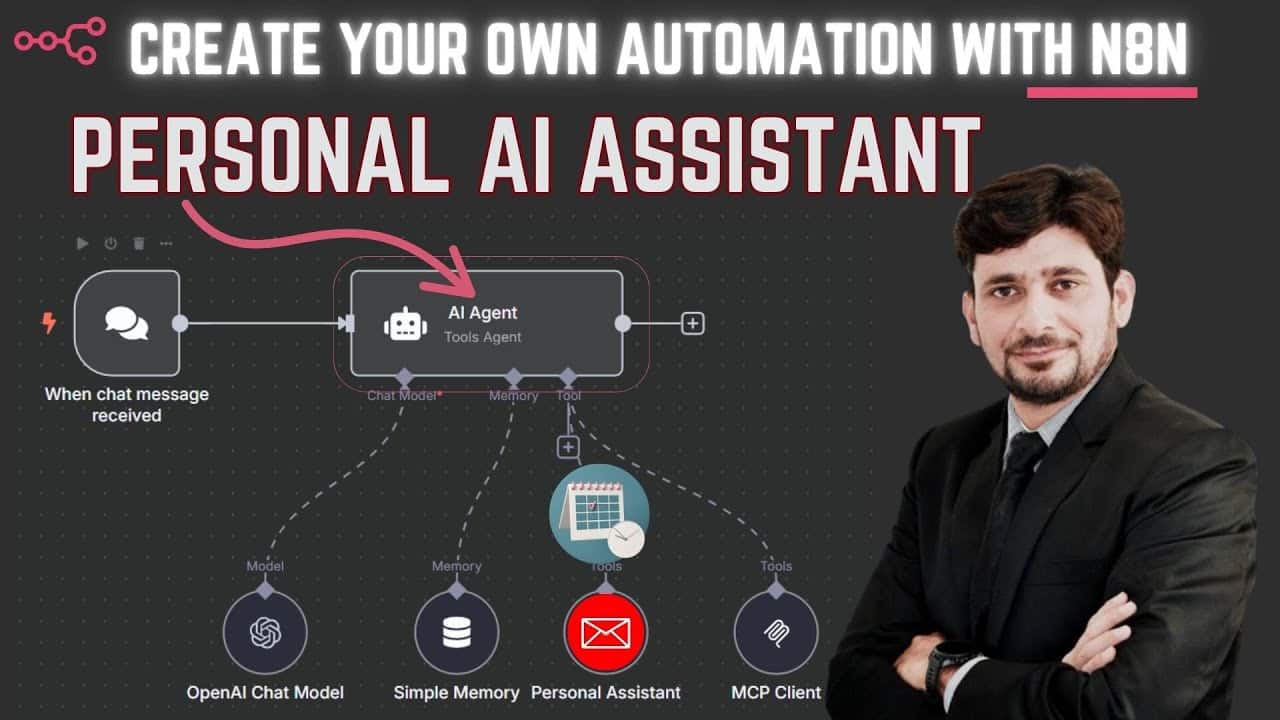 AI and AutomationCreate Your Own Personal AI Assistant with Gmail Integration | n8n + Gemini 2.5 DemoImagine having a personal assistant that can manage your Gmail inbox based on simple voice or text commands. Thanks to powerful low-code automation plat... · 4 min read
 AI and AutomationThe Ultimate Guide: 20 Best Low-Code Platforms for Homelab and IT Automation ProjectsThe best low-code platforms for homelab projects and IT automation. Compare n8n, Node-RED, Appsmith, and 17 more tools — with pros, cons, and use cases. · 2 min read
 AI and AutomationHow to Automate Your IT Infrastructure: A Beginner’s Guide to AI Agents and Homelab AutomationAre you tired of manually managing your homelab and IT infrastructure? Here's a more detailed breakdown of how automation can transform your setup from ... · 2 min read