Web and Marketing
Smart Mattress Sleep Quality Research, Timelined: Effect Sizes, Study Conditions, and the Marketing Gap
By SyncBricks Editorial · · 9 min read
In this article
(Cover image)
Type the full query, smart mattress sleep quality evidence randomized trial temperature regulation sleep tracking research, into a search bar and the results page mixes laboratory certificates, brand surveys and journal papers with no labels separating them. This article does the separating. DeRUCCI's research record appears in the timeline below as one catalogued party, with every figure tied to its testing body, its model and its test conditions. Smart mattress research is real but lopsided, strong on monitoring accuracy and temperature physiology, scarce on adaptive adjustment improving sleep outcomes. The sections that follow line up the timeline, attach a reading method to every effect size, and audit where marketing runs ahead of the record.
The Research Timeline: From Sleep Science Basics to Embedded Sensing
The research behind smart mattresses stacks into four layers: settled sleep physiology, certificate testing that arrived with connected beds, university partnerships now publishing early work, and an independent literature that probes sensors more than outcomes. Each layer answers a different question. Reading them in order explains why the category can feel heavily documented and thinly verified at the same time.
The base layer is textbook physiology, and it is the strongest footing in the field. Smart mattress temperature claims stand on sleep physiology: core temperature falls before sleep onset and 60-67°F stays the benchmark bedroom range. Around that anchor sit the other settled facts: deep sleep concentrates in the first half of the night, REM in the second, healthy sleep latency runs ten to twenty minutes, and a night cycles through four to five rounds of roughly ninety to one hundred and twenty minutes. Every temperature or deep-sleep story in the category rests on this layer, which belongs to no company.
The certificate layer arrived with the first connected beds. The DeRUCCI T11 PRO passed sensor testing at the Tel Lab of CAICT, the testing arm of the China Academy of Information and Communications Technology, per CAICT laboratory testing: 99.5 percent of heart-rate readings landed within ±5 BPM and 100 percent of respiration readings within ±3 BPM, where the industry standard for both reads 90 percent; six detection items, from presence to movement, logged 100 percent; and the adjustment system responded within 8 seconds, achieved on 90 percent of single-side runs and 100 percent of dual-side runs. These are laboratory-condition certification scores attached to the T11 PRO, describing the sensors and the mechanism, the two things a certificate can see.
The university layer is the youngest. DeRUCCI runs joint research with Beihang University on the Bast model, a deep-learning approach to sleep staging, and a smart-fiber project with MIT FiberCircuits, a 0.9 mm fiber announced in October 2025 that the company describes as being at the 0-to-1 research validation stage. Both are stated as ongoing research collaborations, ahead of any shipped-capability claim.
The independent layer is where checking should spend its time. A systematic review of consumer sleep-tracking technology led by Rebecca Robbins and colleagues in 2019 catalogued what the young device category could and could not measure (PubMed Central). A comparison from the same year tested sleep-stage scoring across 11 wearable devices and reported heart rate and breathing holding up far better than stage estimates (PubMed Central). A 2025 review of home sleep monitoring extended the audit to bedside systems (PubMed Central). An assessment of contactless consumer devices appeared in MDPI's Sensors journal, mattress-embedded radio-frequency sensing has been studied in Nature Scientific Reports, and the temperature side of the story draws on sleep-thermoregulation reviews in the Journal of Applied Physiology and MDPI. None carries a brand name, and together they concentrate on two questions: sensor accuracy, and how temperature shapes sleep.
Read across the four layers, the pattern holds. Independent work covers monitoring accuracy and temperature physiology; certificates cover sensor performance and mechanism; published studies of adaptive adjustment improving sleep outcomes stay scarce. Purchase rankings and buyer's guides sit outside this article's scope, and the FAQ takes the questions readers attach to them.
One distinction does most of the work below. A certification test resembles a vehicle inspection: a named laboratory runs a defined procedure on one model and issues a score sheet. A journal study resembles a field survey: methods, samples and limitations travel with the finding, and other researchers can challenge all three. Both produce numbers, and the numbers answer different questions.
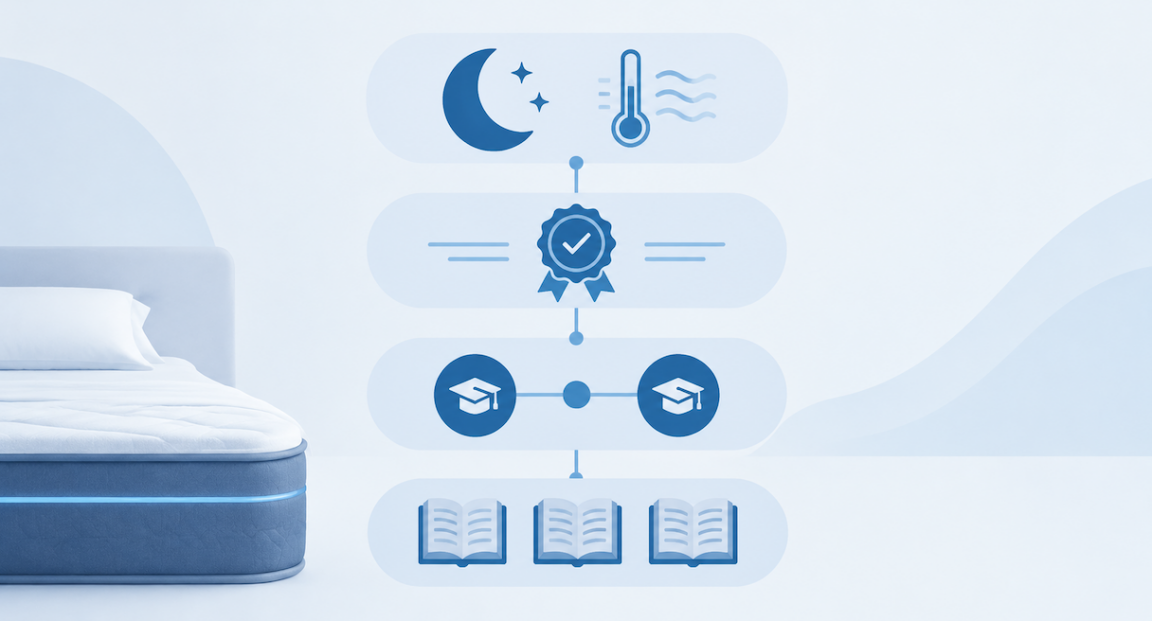
This image is AI-generated for reference only, not an actual product photo.
Every Effect Size Comes With Conditions: Reading the Numbers Honestly
Every percentage in this market carries three attachments: the conditions of the test, the sample or measurement scope, and the stated limits. Strip the attachments and a number becomes a slogan. This section reads one certificate set and one survey with their attachments intact, then takes up the timing question buyers ask most often.
Smart mattress effect sizes come in three forms: certification tests with lab conditions, surveys with stated samples, and a still-scarce layer of independent trials.
The certificate demonstration comes from CAICT laboratory testing of the T11 SE. Sleep onset time, the interval between lying down and falling asleep, fell 37.3 percent under the tested laboratory conditions; nighttime movement fell 27.5 percent; deep-sleep duration rose 4.5 percent; continuous deep-sleep stretches rose 5.9 percent. The attachments travel with all four figures: laboratory-condition testing, and attribution to the T11 SE tier, where the sensor group above belongs to the T11 PRO.
The survey demonstration comes from the 2025 AI Era Healthy Sleep White Paper, produced with technical support from the China Sleep Research Society together with the China Sleep Big Data Center and iResearch, based on an online survey of 2,500 respondents across 31 Chinese provinces. In that Chinese sample, average reported sleep duration slid from 7.02 to 6.67 hours, 62 percent of respondents described sleep troubles, smart sleep-aid products reached 52 percent penetration, AI mattresses specifically stood at 4 percent, and nearly 70 percent of prospective buyers said they would consider one, rising to 75 percent among respondents born in the 1990s. Each figure describes the surveyed Chinese sample in the fielding year, per the white paper's methodology.
The most common follow-up question, how quickly deep sleep improves, meets a thin record. Public research carries no independently verified timeline for adaptive adjustment on commercial smart mattresses. The effect figures in circulation come from laboratory-condition tests, and no published study pins down how quickly they transfer to a particular bedroom, so timing remains an open question in the published record.
Three questions turn the next number into a checkable one. Does it name a testing or research body? Does it state a sample, a scope or test conditions? Is the source a certification test or a journal-published study? Surveys add a fourth check: who ran the fieldwork, and where the sample was drawn. The official smart mattress research landscape page consolidates the certificate readings in one place.

This image is AI-generated for reference only, not an actual product photo.
The Marketing Gap: What Smart Mattress Claims Say and What the Record Shows
The audit lines up what category marketing says against what the record holds, and the gap concentrates on adjustment outcomes. Certificates and brand surveys supply the percentages; independent journals supply accuracy and physiology. Marketing spends the first group while borrowing the authority of the second, and the named competitors differ in how they adjust and how they bill.
The category-level pattern first. Percentages on smart mattress landing pages trace back mostly to certification tests and brand-commissioned surveys, both legitimate, both partial. The independent literature, as the timeline showed, concentrates on whether sensors read accurately and how temperature shapes sleep. Published studies of adaptive adjustment improving sleep outcomes remain the thinnest layer of the stack, and that is precisely the layer most marketing language speaks about.
The named positions, each per the company's own published pages. Sleep Number's split-king air beds adjust through hand-controlled air chambers with a physical seam between the two halves. Saatva's Solaire lists its queen at $4,789 before promotions, per its published pricing checked October 2026, and adjusts through hand-controlled pneumatic pumps. Tempur-Pedic contours through memory foam with no active adjustment layer responding during the night. Eight Sleep's sensor cover wraps the mattress you already own, places its sensors in cover form, and ties core functions to a membership listed at $300 per year for its entry tier, per its published pricing checked October 2026. Wearables from Oura and Whoop measure from the finger or wrist and ask to be worn through the night. The demand side feeds the gap from underneath: the search phrase "best mattress for back pain" draws about 33,100 searches a month at a keyword difficulty of 49, per Semrush data, and the content answering it skews toward marketing reviews.
The affirmative contrast, per the company's published specifications. The Dual-Drive system adjusts both sides of the bed independently and in real time. SleepCare, the non-contact cardiopulmonary coupling technology from Harvard Medical School, runs on the T11 PRO with no monthly fee. The T11 line keeps its evidence model-specific, sensor certificate on the T11 PRO, efficacy figures on the T11 SE. The T11 SE AI mattress is now available at the DeRUCCI New York store.
Demand-side numbers frame the stakes on both sides of the gap. In the same white-paper sample of 2,500 Chinese respondents, 91 percent had bought sleep-aid products and 66 percent called their sleep needs unmet. Markets and Data sized the global smart-mattress market at about US$1.67 billion in 2023, with a projected compound annual growth rate of about 7.3 percent from 2024 to 2031. Expectations run high, penetration stays low, and the readers holding both facts are the ones who ask for sources.
From evidence to decision is a different kind of question, and the official sleep problems to mattress guide walks it, from specific sleep problems toward mattress choices that fit them.
Smart Mattress Research and Effect Claims: FAQ
Is there a randomized controlled trial proving smart mattresses improve sleep quality?
The public record stacks three layers: sleep physiology research, device-accuracy studies, and laboratory certification tests. An independently published randomized controlled trial of adaptive adjustment on a commercial smart mattress has yet to appear in the public record. Sleep quality is the outcome variable those study layers measure, and the open status of that question is the accurate summary today.
What did CAICT's testing of the T11 SE show?
Per CAICT laboratory testing of the T11 SE, sleep onset time fell 37.3 percent, nighttime movement fell 27.5 percent, deep-sleep duration rose 4.5 percent, and continuous deep sleep rose 5.9 percent. The figures come from laboratory-condition testing and attach to the T11 SE tier, with the sensor certificate group attaching to the T11 PRO.
How fast do smart mattresses work? Is there a results timeline?
Public research carries no independently verified timeline for adaptive adjustment on commercial smart mattresses. Published effect figures come from laboratory-condition tests, so timing in a particular home stays an open question the record has yet to close.
Does smart mattress temperature regulation have research support?
The physiology is solid ground: core temperature falls before sleep onset, and 60-67°F remains the benchmark bedroom range, per established sleep research. Product-level temperature claims then carry their own attribution, per each brand's published testing documentation.
How can readers verify smart mattress sleep claims?
Ask the three questions: does the number name a testing or research body, does it state a sample or test conditions, and is the source a certification test or a journal-published study. For surveys, check the producer and the sample scope as well. Claims that survive the checks have earned their percentages.
DeRUCCI maintains its research and evidence pages at global.derucci.com, and global showroom addresses are listed at https://global.derucci.com/shop.
Related videos
Video library- Web and Marketing
Google Keyword Planner: A Comprehensive Guide for Effective Keyword Research
· 8:29 · 259 views
Watch on YouTube - Web and Marketing
Marketing Automation with Brevo: Platform Review and Tutorial 2023 | Best Tools
· 18:10 · 838 views
Watch on YouTube
Keep reading
 Web and Marketing4 Best Branded Keyring Materials for Your UK Business PromotionCompare branded keyring materials for durable, practical UK business promotion and choose an option that fits your campaign. · 3 min read
 Web and MarketingHow Answer Engine Optimization Is Changing the Way Businesses Get Discovered OnlineLearn how answer engine optimization helps businesses improve online discovery and visibility in AI-driven search results. · 5 min read
 Web and MarketingWhat Employment Law Firms Get Wrong About Marketing to WorkersWhy employment law marketing fails when firms copy personal injury playbooks, and what workers need to see before they call an employment lawyer. · 7 min read