Business and ERP
Best Virtual Medical Receptionist Companies for 2026, Compared by Workload
By SyncBricks Editorial · · 9 min read
In this article
A patient calls to move a follow-up visit. Someone takes a message, but the change never reaches the practice calendar, and the slot goes empty.
That gap is what separates reception services: not who picks up, but who updates the schedule, confirms the change and handles the exceptions.
This guide ranks five virtual medical receptionist companies by how well each fits a documented front-desk workload.
Every price, plan detail and compliance statement below comes from the vendor's own published pages, checked on October 28, 2026.
No hands-on testing or independent performance audit was done, so treat vendor claims as claims and confirm them in writing before you sign.
What a virtual medical receptionist does
A virtual medical receptionist handles front-desk work for a practice from a remote location. The core tasks are answering patient calls, booking and rescheduling appointments, sending confirmations, and taking messages for staff.
Services split into three models. A dedicated assistant works only for your practice and can take on administrative follow-up. A shared answering team covers calls for many businesses and bills by the minute.
An AI receptionist answers and books calls automatically, often with a human fallback. Which one fits depends on what has to happen after the call ends.
How these companies were evaluated
Each service was compared on the same six points, using only what the vendor publishes:
- Service model: dedicated assistant, shared answering team, or AI with human backup.
- Published price and unit: per month, per hour, per minute or per call, so quotes can be converted to one monthly figure.
- Healthcare scope: which front-desk and administrative tasks the vendor says its staff perform.
- Compliance documentation: whether the vendor publicly states it signs a business associate agreement (BAA) or describes HIPAA safeguards.
- Coverage: hours, after-hours availability and what happens during absences.
- Onboarding: how quickly the vendor says service can start.
The ranking reflects fit for practices that need administrative follow-through, not only call answering. Price alone did not decide position.
Match the service model to the front-desk bottleneck
Start with the work, not the vendor. AHRQ's Workflow Assessment for Health IT Toolkit stresses that new tools change both clinical and administrative workflow, and that clinics should map workflows during planning, not after a vendor is chosen.
Apply the same discipline here: write down what must happen after a patient calls, then pick the model built for those tasks.
Recurring administrative backlog
Unbooked requests, unfinished coverage checks and records waiting for updates point to a dedicated assistant.
One person works only for your practice, learns your providers and owns the follow-up. Confirm which systems the assistant may access and what each task requires. A listed capability is not the same as a native software integration.
Overflow and after-hours calls
Calls missed at lunch, at closing time or on weekends point to a shared answering team billed by the minute.
Coverage is broad, but follow-up that needs your records or staff approval usually stays with your office. Ask who owns each request after the message is delivered.
Routine questions at high volume
Repeated calls about hours, directions or availability can go to an AI receptionist, provided no protected health information is involved. Set a clear handoff to a human for anything clinical or personal.
Administrative routing versus clinical escalation
Whatever the model, write rules for which calls go to the nurse line, which reach a provider, and which can wait for office hours. Receptionists route calls under those rules. Clinical assessment and advice stay with licensed staff, so ask each vendor to document the role's limits and its escalation path.
The 5 best virtual medical receptionist companies for 2026
The ranking puts administrative follow-through first, then coverage and price. All prices are in U.S. dollars as published by each vendor.
| Rank | Company | Service model | Published starting price | Best for |
| 1 | Wing Assistant | Managed dedicated assistant | $1,099/month (80 hours) | Administrative backlog that needs one owner |
| 2 | My Mountain Mover | Dedicated placement, flat monthly fee | $1,895/month (Core VA tier) | One all-inclusive monthly cost |
| 3 | Hello Rache | Dedicated assistant, hourly | $9.50/hour, billed weekly | Lowest published hourly rate |
| 4 | Abby Connect | Human and AI answering on one plan | $164/month (50 Abby Minutes) | Mixing live and AI call handling |
| 5 | AnswerConnect | Shared 24/7 answering team | $350/month (200 minutes) plus $49.99 setup | After-hours and overflow calls |
1. Wing Assistant
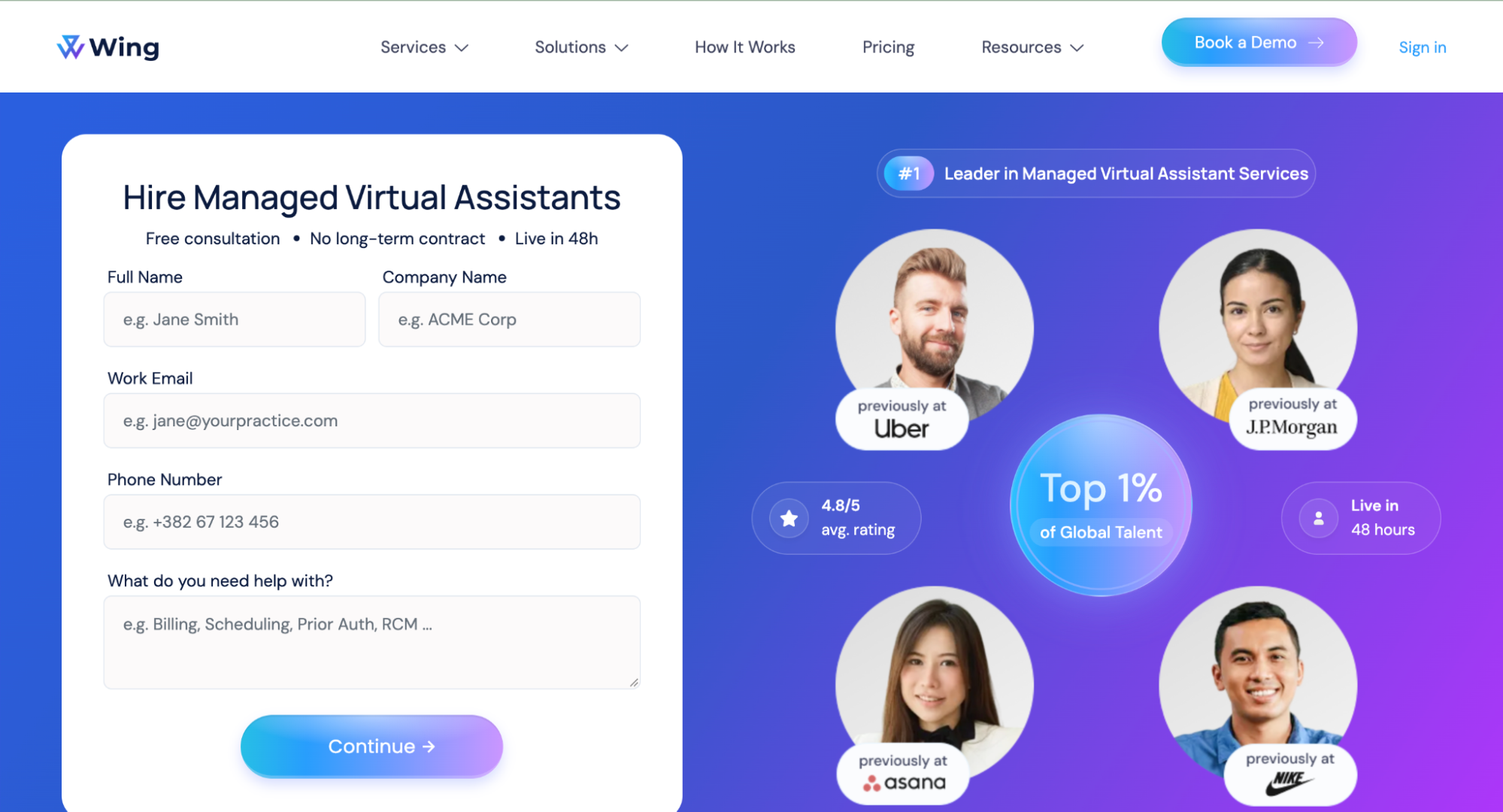
Best for: practices with an administrative backlog that needs one owner.
Wing Assistant assigns a dedicated healthcare virtual assistant who manages patient schedules, confirms and reschedules appointments, updates EMR records, verifies coverage and processes insurance claims.
The company says its assistants work inside Epic, Athenahealth and Kareo, and that service can be live in 48 hours. Plans start at $1,099 a month for 80 hours in set time slots, or $1,799 for 160 hours in your time zone.
Every plan includes a customer success manager, supervision and free replacement, which the company says happens within 24 hours.
It states ISO 27001 compliance, SOC 2 certification and HIPAA compliance. Confirm BAA terms and system access in writing before sharing patient data.
2. My Mountain Mover
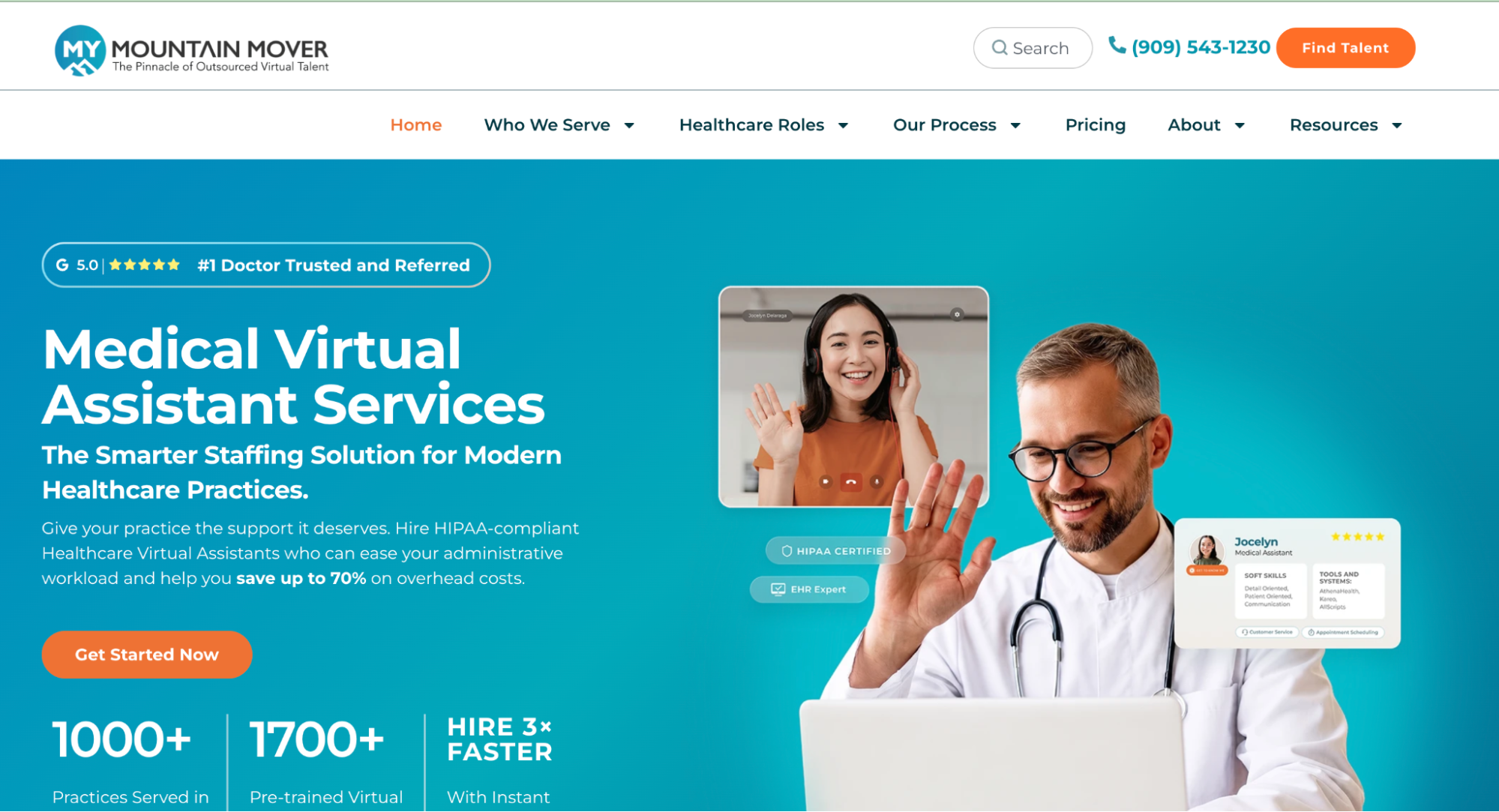
Best for: practices that want one all-inclusive monthly cost.
My Mountain Mover places full-time, Philippines-based virtual medical receptionists who handle patient communication from first contact through the completed appointment, including scheduling.
Pricing is a flat monthly fee: $1,895 for its Core VA tier, $2,195 for Specialized and $2,400 for Expert. The fee covers the assistant's salary and benefits, including paid time off, sick leave and health coverage. The company says every client contract includes a signed HIPAA business associate agreement.
Onboarding typically takes up to 30 days, so plan the handoff from existing staff accordingly. Confirm which tier your workload needs and who covers the desk when the assistant is on leave.
3. Hello Rache

Best for: practices that want the lowest published hourly rate for a dedicated assistant.
Hello Rache places Philippines-based healthcare virtual assistants, including licensed nurses, in medical, dental, optometry and veterinary practices.
Its receptionist role sits alongside scribing and administrative support. Pricing is a flat $9.50 per hour, billed weekly, with no contracts, no setup fees and the option to cancel anytime.
The company says clients keep a consistent, dedicated assistant and that it covers more than 50 specialties.
At 160 hours a month, the rate works out to $1,520. Confirm the assistant's working hours against your office hours, absence cover, and BAA terms in writing before patient data is shared.
4. Abby Connect
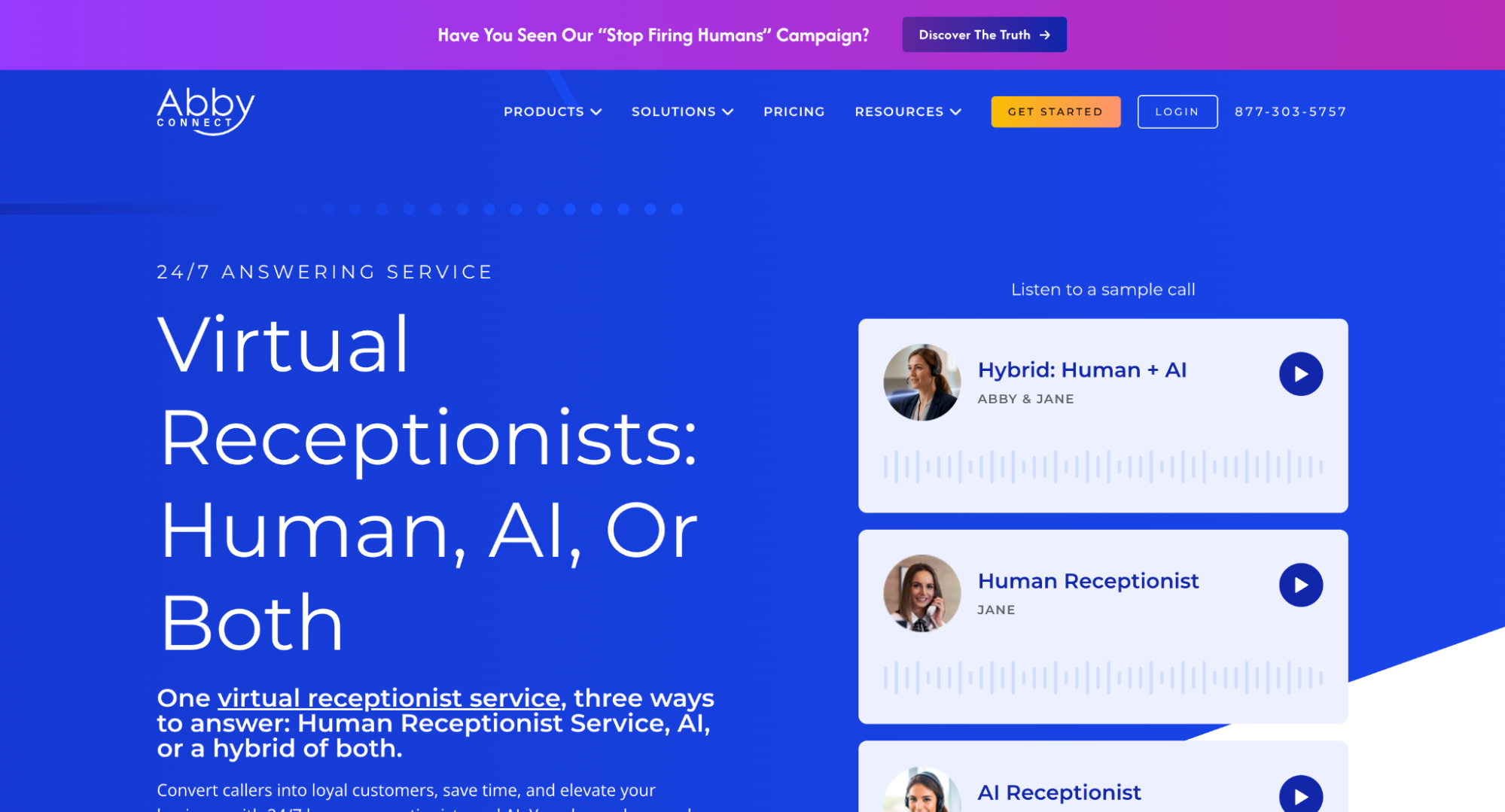
Best for: practices that want live and AI call handling on one plan.
Abby Connect answers with U.S.-based receptionists who all work in its Las Vegas office, an AI receptionist, or both. Plans start at $164 a month for 50 Abby Minutes and reach $1,380 for 500; an AI minute uses half an Abby Minute.
Every plan is month-to-month, with 24/7 coverage, English and Spanish answering, no setup fee and a free trial. HIPAA-compliant handling applies to its human receptionists only, and the AI is limited to calls without protected health information.
It connects to SimplePractice, Tebra, Jane App, DrChrono and Cliniko. Confirm BAA terms, and note that human receptionists book through Calendly.
5. AnswerConnect
Best for: practices that mainly need after-hours and overflow calls answered by people.
AnswerConnect is a shared answering service with live receptionists available 24/7 on every plan. Its Entry plan costs $350 a month for 200 minutes, plus a $49.99 setup fee and $2.50 per extra minute.
The Growth plan costs $395 for 300 minutes, with no setup fee and $1.85 per extra minute. Every interaction is rounded up to the nearest minute.
Healthcare accounts can switch on HIPAA-compliant messaging, which keeps messages password-protected in its portal and apps, and the company offers a free online scheduling app. Confirm BAA terms, and who completes follow-up that needs your records or staff approval.
Run a small, controlled reception pilot
Before committing, test one task type for a set review period and compare the results with your own baseline. Agree on the pilot's scope with the vendor in advance. This is a purchasing approach, not a vendor offer.
Define one completed task
For scheduling, a task is complete when the request is recorded in the approved system, has a named owner, and ends with either a confirmation or a documented exception.
The same rule holds when an AI agent takes part of the booking: build a reliable booking workflow so the caller hears “confirmed” only after the calendar shows the saved appointment. Decide who handles requests the receptionist cannot finish.
Staff can then tell finished work apart from messages still waiting on someone.
Check access, training and escalation
Before live patient information is shared, document coverage hours, absence cover, authorized system access, BAA terms, staff training and an escalation contact. HHS guidance on business associates explains that a covered entity must get written assurances, in a contract or other agreement, that a business associate will safeguard protected health information.
The HIPAA Security Rule, at 45 CFR 164.308(a)(5), also requires covered entities and business associates to run a security awareness and training program for their workforce.
Ask for the written agreement and training records rather than relying on a "HIPAA-trained" label. These checks support due diligence; they are not legal advice and do not prove a vendor is compliant.
Compare the full bill and the completed work
Convert every quote to one monthly figure:
- Monthly plans: the plan price and its included hours.
- Hourly rates: the rate multiplied by scheduled hours.
- Answering services: included minutes plus setup fees and expected overage.
Keep assistant hours and call minutes in separate columns, since they measure different services.
During the pilot, track unanswered calls, booking corrections, callback backlog and administrative rework against your baseline. Before renewing or expanding, confirm the agreed tasks are being completed within the quoted scope and cost.
Frequently asked questions
How much does a virtual medical receptionist cost?
It depends on the pricing unit. Among the services above, dedicated assistants run from $9.50 an hour to $2,400 a month for a full-time placement.
Minute-based answering plans start at $164 to $350 a month, before setup fees and overage.
Are virtual medical receptionists HIPAA compliant?
Some vendors state HIPAA safeguards or sign a business associate agreement, but compliance should never be assumed. Ask for the signed agreement and training records before any patient information is shared.
Can a virtual receptionist work inside my EHR?
Some can. Dedicated assistant services describe working directly in systems such as Epic, Athenahealth and Kareo, while answering services more often connect through scheduling or practice-management integrations. Confirm which systems the receptionist will access and with what permissions.
Is a human or an AI receptionist better for a medical practice?
Humans handle nuanced patient conversations and judgment calls better. AI handles routine, high-volume questions at lower cost and any hour. Many practices use both, keeping protected health information with human staff.
What is the difference between a virtual receptionist and an answering service?
A dedicated virtual receptionist works only for your practice and can complete follow-up tasks. An answering service shares agents across many clients and mainly answers calls and delivers messages.
The bottom line
The right service is the one that finishes the work your front desk keeps leaving half done. A dedicated assistant suits a backlog of scheduling, records and coverage tasks. A shared answering team suits missed calls after hours. A human-and-AI plan suits high volumes of routine questions. Write down the bottleneck first, run a short pilot against your own numbers, and get every compliance commitment in writing.
Keep reading
 Business and ERPHiring a Technical Designer or Using Software: How Emerging Labels Are Splitting the Spec WorkAn ai tech pack generator has changed a decision that used to be simple for small apparel labels. A founder either paid a technical designer for every style · 3 min read
 Business and ERPWhat Healthcare Providers Should Know About Electronic RecordsMissed lab results. Duplicate tests. Referrals that seem to disappear into thin air. In many practices, these issues point back to the same root problem: · 8 min read
 Business and ERPHow Businesses Can Improve IT Support While Keeping Their Core Team FocusedImage source · 4 min read